 Dhel Malith CholApril 8, 2026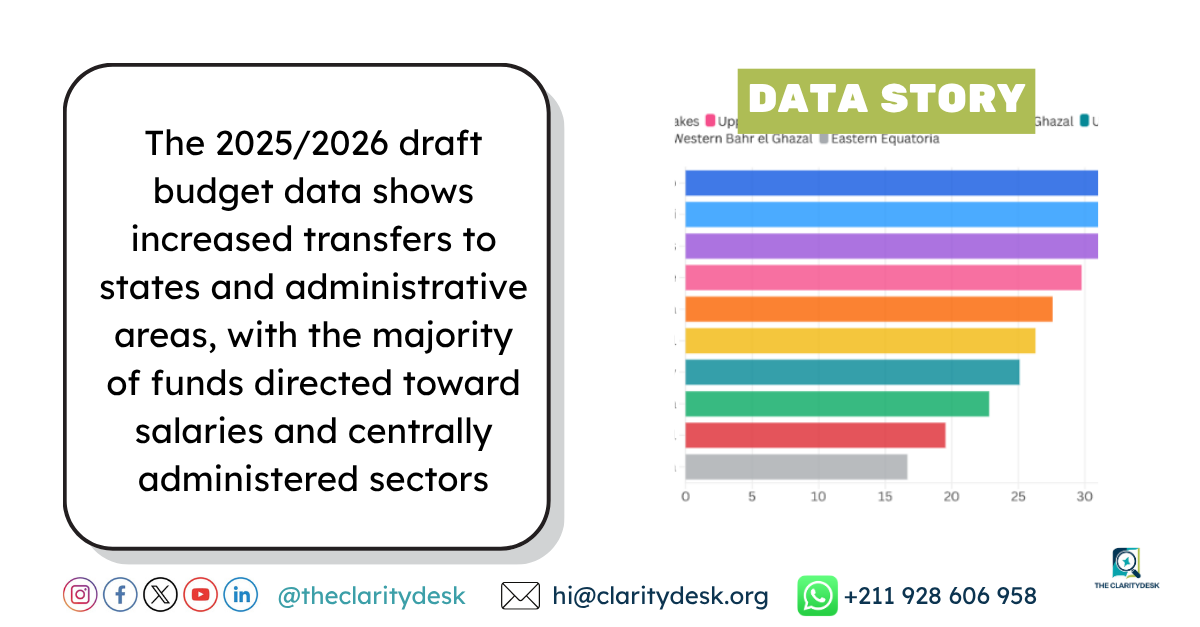
South Sudan’s draft national budget for the 2025/26 fiscal year proposes transferring 548.94 billion South Sudanese pounds (SSP) to states and administrative areas, according to detailed expenditure tables reviewed by Radio Tamazuj. The proposed allocation represents a notable increase compared to the 344.06 billion SSP reportedly disbursed to subnational governments during the 2024/25 fiscal year.
Graph 1.0 showing State Transfers: Previous vs Proposed Budget
Source: Flourish
The data indicates that Warrap State is set to receive the largest allocation at 38.16 billion SSP. Jonglei State follows with 34.14 billion SSP, while Lakes State is allocated 31.30 billion SSP. Upper Nile State is expected to receive 29.76 billion SSP and Central Equatoria State 27.58 billion SSP.
Other allocations include 26.29 billion SSP for Northern Bahr el Ghazal, 25.09 billion SSP for Unity State, and 22.81 billion SSP for Western Equatoria. Western Bahr el Ghazal is allocated 19.52 billion SSP, while Eastern Equatoria State is projected to receive 16.66 billion SSP under the proposed transfer framework.
Graph 2.0 showing the Proposed Transfers to South Sudan States (2025/26).
Source: Flourish
The draft budget also outlines allocations for the country’s three administrative areas. Greater Pibor Administrative Area is allocated 9.03 billion SSP, followed by Ruweng Administrative Area with 5.31 billion SSP and the Abyei Administrative Area with 3.86 billion SSP.
Graph 3.0 showing the Allocations to Administrative Areas.
Source: Flourish
A breakdown of the transfer envelope shows that a significant portion of the funds is intended to support government payrolls. Out of the total allocation, 335.18 billion SSP is ring-fenced for conditional salary transfers. Operating costs account for 204.26 billion SSP, while 9.50 billion SSP is directed toward service delivery units, mainly within the health sector.
Budget tables further indicate that a large share of these transfers will be administered through national ministries rather than disbursed directly to state governments. The Rule of Law sector receives the largest allocation at 150.33 billion SSP to support police services, prisons and fire prevention activities. The education sector is allocated 103.91 billion SSP for basic and post-primary education programmes, while Natural Resources and Rural Development is set to receive 77.37 billion SSP, largely linked to wildlife and tourism activities.
Graph 4.0 showing the Largest Sector Allocations Within State Transfers.
Source: Flourish
The transfers to states and administrative areas are separate from other mandatory expenditures with regional implications. These include 846.67 billion SSP in oil-related transfers to Sudan as well as constitutionally mandated shares for oil-producing states and communities, which are listed elsewhere in the draft budget.
Overall, the proposed national budget projects total government expenditure of 8.58 trillion SSP against expected revenues of 7.01 trillion SSP, resulting in a financing gap estimated at 1.57 trillion SSP.
Graph 5.0 showing South Sudan 2025/26 Budget Overview.
Source: Flourish
The draft budget was presented to lawmakers by Finance Minister Bak Barnaba Chol and is subject to debate and approval by the Transitional National Legislative Assembly before implementation. The parliamentary finance committee has scheduled public hearings on the budget as part of the review process.
The allocation figures provide an overview of planned fiscal transfers to subnational governments for the upcoming financial year, pending parliamentary approval and subsequent implementation.
This article is published by The ClarityDesk through the Young Journalists Media Integrity Fellowship, with the support of the Election Civic Tech Fund of AfricTivistes, within the AHEAD Africa and Digitalise Youth projects, led by the Digital Democracy Initiative.
Have you spotted an error in this article and would like to request a correction, or have you come across a claim that we should investigate? Please send us an email via editor@claritydesk.org or click here to WhatsApp us via +211 928 606 958.
About The ClarityDesk
The ClarityDesk is a media integrity project based in South Sudan dedicated to promoting truth, transparency, and accountability. Working at the intersection of fact-checking, solutions and data journalism, we verify claims, debunk misinformation, and equip the public with tools to critically evaluate information. Our work is guided by accuracy, independence, and the public interest.