The ClarityDeskJuly 21, 2026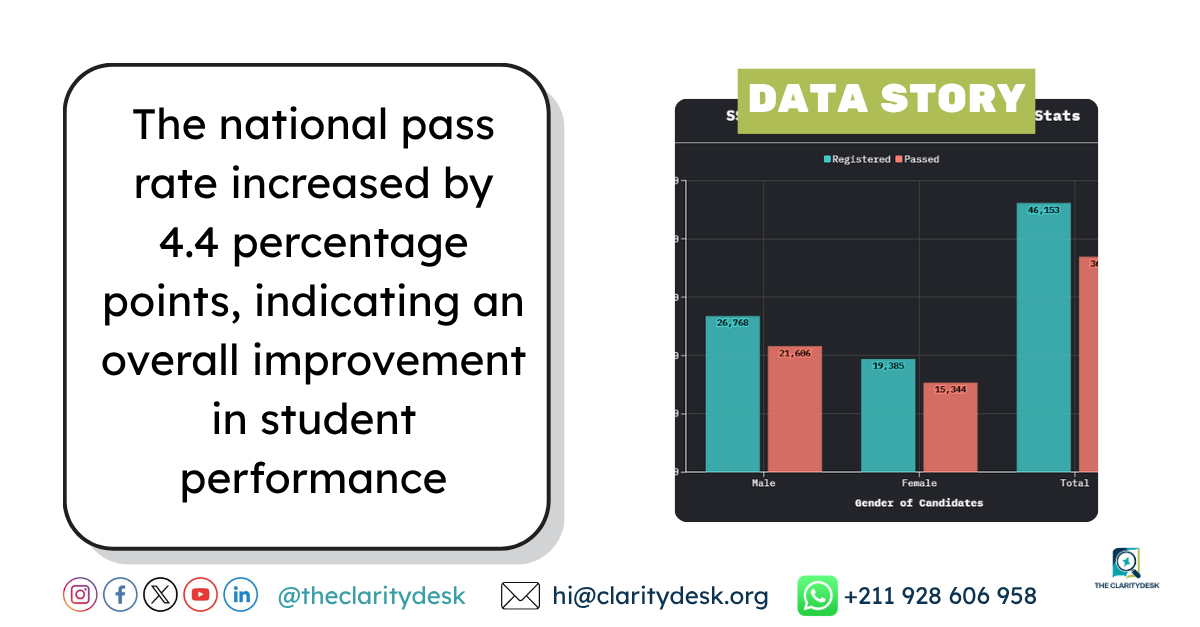

South Sudan has recorded an improvement in the performance of candidates who sat for the South Sudan Certificate of Secondary Education Examinations (SSCSE) in 2025, with the national pass rate increasing to 80.7%, up from 76.3% in 2024.
The Ministry of General Education and Instruction (MoGEI), through the National Examination Council (NEC), officially released the 2025 examination results on 2 June 2026 after they were approved by President Salva Kiir a day earlier.
According to the Ministry, 46,153 candidates registered for the examinations, including 26,768 males and 19,385 females, across 521 secondary schools nationwide.
Out of those who sat for the examinations, 36,950 candidates successfully passed, including 21,606 males and 15,344 females, giving the country an overall pass rate of 80.7%.
| Gender | Registered | Passed |
| Male | 26,768 | 21,606 |
| Female | 19,385 | 15,344 |
| Total | 46,153 | 36,950 |
A table showing statistics of registered candidates
https://public.flourish.studio/visualisation/29752435/

Male candidates slightly outperformed female candidates, recording an 81% pass rate compared to 79.2% among females. Subject analysis showed that Christian Religious Education (CRE), Agriculture and Biology were the most improved subjects, while General Science, Citizenship and Commerce recorded the weakest performance.
The National Examination Council also nullified the examination results of 87 candidates from Nimule Model Secondary School and awarded zero marks to 23 candidates after they were found guilty of examination malpractice.
Among individual performers, Maduet Mangong Maduet from Darling Wisdom Academy, Pentagon Campus, emerged as the country’s top candidate with 88.9%, while Nyaduok Chol Dep was the highest-performing female candidate with 88%.
The Office of the President also confirmed that President Salva Kiir approved the results before their official release and reiterated the government’s commitment to improving education across the country.
Comparative Analysis
Compared with 2024, the 2025 examination results show continued improvement.
| Year | Percentage Pass |
| 2024 | 76.3% |
| 2025 | 80.7% |
A tablet showing the national pass rate (2024 vs 2025)
https://public.flourish.studio/visualisation/29752499/

A pie chart showing the national pass rate (2024 vs 2025)
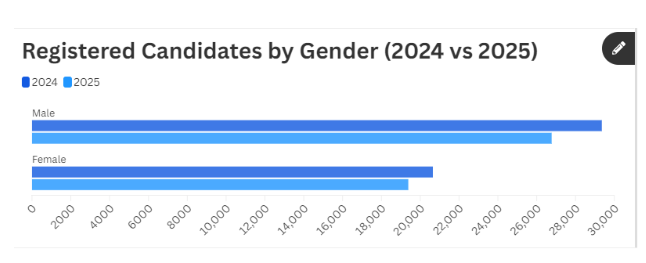
The number of registered candidates declined from 50,004 in 2024 to 46,153 in 2025. Male registrations decreased from 29,353 to 26,768, while female registrations fell from 20,651 to 19,385. Despite the drop in total registrations, the 2025 examination recorded a higher national pass rate than the previous year.
| Year | Male | Female | Total |
| 2024 | 29,353 | 20,651 | 50,004 |
| 2025 | 26,768 | 19,385 | 46,153 |
Table showing registered candidates by gender (2024 vs 2025)
Male candidates recorded a slightly higher pass rate than female candidates in the 2025 secondary school examinations. The pass rate among males was 81.0%, compared to 79.2% among females, showing a difference of 1.8 percentage points.
Out of the 45,776 candidates who sat for the 2025 Secondary School Examinations, 36,950 candidates passed, while approximately 8,826 candidates did not pass. This means the majority of students successfully achieved certification, contributing to the national pass rate of 80.7%.
The comparison shows that although the number of registered candidates and examination centres decreased in 2025, the overall performance improved. The national pass rate rose from 76.3% in 2024 to 80.7% in 2025, with 249 more candidates passing than in the previous year.
Female candidates recorded a slight increase in the number of passes, while the number of male candidates who passed remained almost unchanged. Overall, fewer candidates failed the examinations in 2025, indicating an improvement in student performance.
The national pass rate increased by 4.4 percentage points, indicating an overall improvement in student performance.
Despite this progress, concerns remain over the performance of public schools. According to a report by Sudan’s Post, lawmakers urged the Ministry of General Education and Instruction to improve the quality of public education after private schools dominated the top positions in the
Conclusion
The South Sudan Certificate of Secondary Education Examination (SSCSE) results reflect encouraging progress in South Sudan’s education sector. While the overall pass rate improved compared with 2024, the performance gap between public and private schools, together with weak results in some subjects, suggests that more investment is needed in teacher training and education quality.
This article is published by The ClarityDesk through the Young Journalists Media Integrity Fellowship, with the support of the Election Civic Tech Fund of AfricTivistes, within the AHEAD Africa and Digitalise Youth projects, led by the Digital Democracy Initiative.
Have you spotted an error in this article and would like to request a correction, or have you come across a claim that we should investigate? Please send us an email via editor@claritydesk.org or click here to WhatsApp us via +211 928 606 958.
About The ClarityDesk
The ClarityDesk is a media integrity project based in South Sudan dedicated to promoting truth, transparency, and accountability. Working at the intersection of fact-checking, solutions and data journalism, we verify claims, debunk misinformation, and equip the public with tools to critically evaluate information. Our work is guided by accuracy, independence, and the public interest.