The ClarityDeskJuly 7, 2026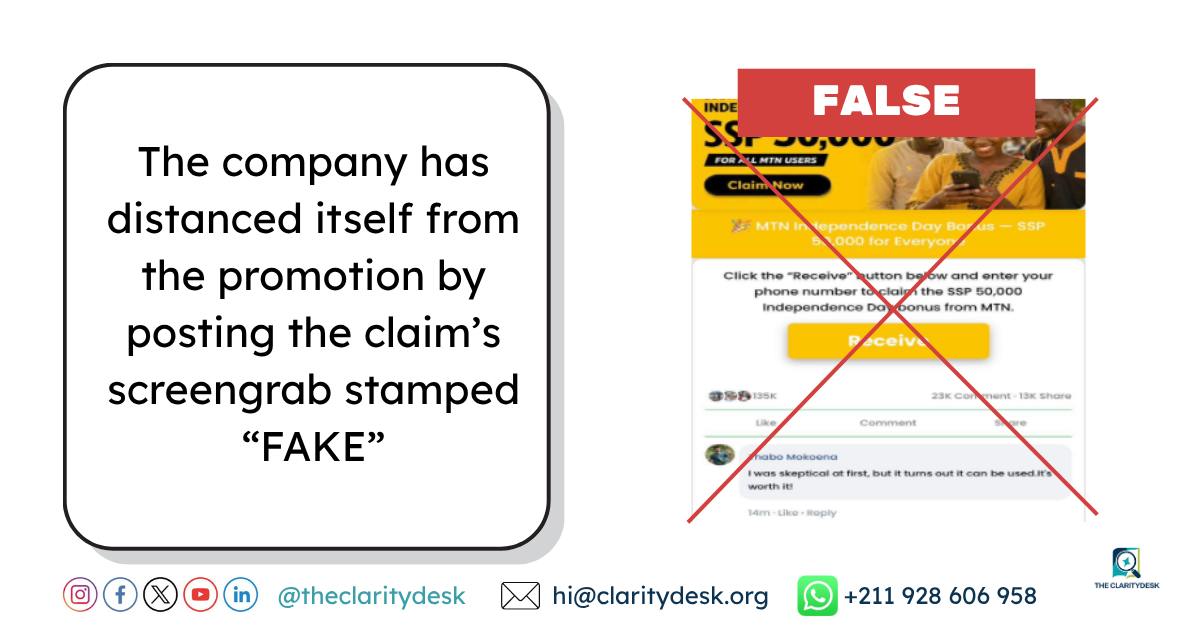

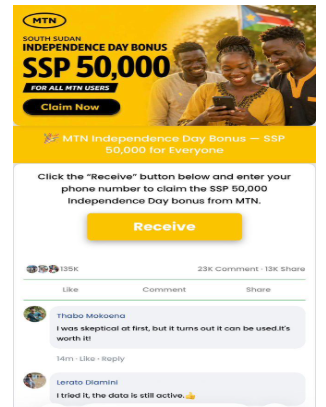
A message circulating on WhatsApp (archived) claims that MTN South Sudan is giving every customer SSP 50,000 for South Sudan Independence Day bonus, but this is false.
“MTN South Sudan is giving an Independence Day bonus of SSP 50,000 for everyone. I already received SSP 50,000. Check if you can also claim it,” reads the message being circulated on WhatsApp and urges users to click a link to claim the reward.
After clicking the link, it requests the user to enter their phone numbers, after which it instructs the user to share the link with contacts or groups on both WhatsApp and Facebook Messenger.
Debunking the Claim:
The ClarityDesk checked MTN South Sudan’s official website and official Facebook page. There is no announcement about an Independence Day bonus of SSP 50,000.
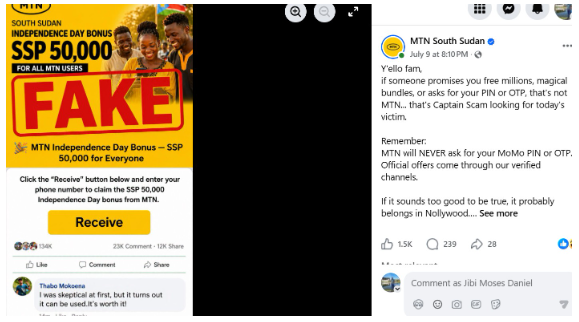
The Company’s official Facebook page has instead published a disclaimer about the same claim saying that it is fake.
Secondly, the promotion is hosted on a non-official website. The claim directs users to zxyy.olhtj.xyz which is not an official MTN South Sudan domain.
The page also requires users to share the link with five WhatsApp groups or 15 friends before claiming the reward. This is a common tactic used by viral scam campaigns to increase their reach.
The page further displays fake progress bars and generic social media comments designed to make the offer appear genuine.
This publication also did website security scans through VirusTotal and some of the security vendors flagged the URL as malicious at the time of analysis.
Similarly, a domain analysis using URLVoid, showed the first Seen 1 hour before the scan with a detection Count of 0/35 and domain registration in 2026-06-10 (approximately 28 days old). These findings indicate the domain is relatively new and had not yet been flagged by security databases at the time of analysis.
Our Verdict:
The ClarityDesk has found a claim that MTN South Sudan is offering a bonus of SSP 50,000 to mark South Sudan Independence Day 2026 to be false. The company has distanced itself from the promotion by posting the claim’s screengrab stamped “FAKE”.
This article is published by The ClarityDesk through the Young Journalists Media Integrity Fellowship, with the support of the Election Civic Tech Fund of AfricTivistes, within the AHEAD Africa and Digitalise Youth projects, led by the Digital Democracy Initiative.
Have you spotted an error in this article and would like to request a correction, or have you come across a claim that we should investigate? Please send us an email via editor@claritydesk.org or click here to WhatsApp us via +211 928 606 958.
About The ClarityDesk
The ClarityDesk is a media integrity project based in South Sudan dedicated to promoting truth, transparency, and accountability. Working at the intersection of fact-checking, solutions and data journalism, we verify claims, debunk misinformation, and equip the public with tools to critically evaluate information. Our work is guided by accuracy, independence, and the public interest.