Emmanuel BidaJanuary 14, 2026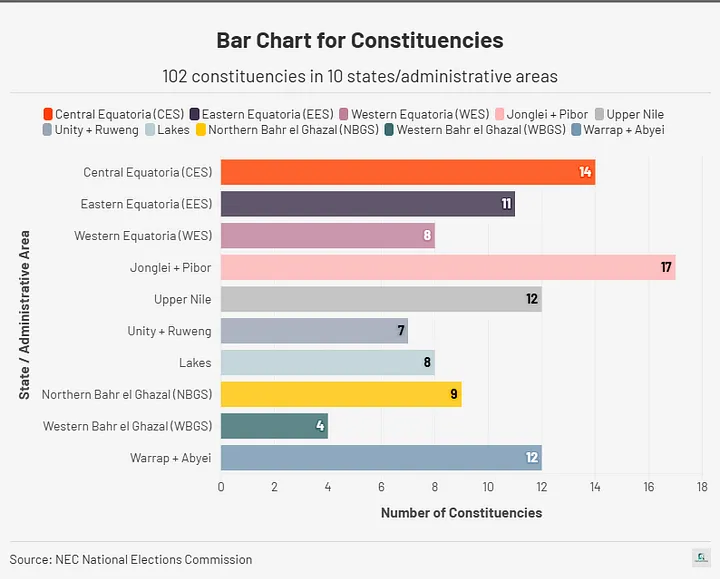
South Sudan’s National Elections Commission (NEC) has confirmed that the December 2026 general elections will proceed using the 2010 geographical constituency boundaries in the absence of a new national census.
Chair of the National Elections Commission, Prof. Abednego Akok Kacuol announced the decision on 22 December 2025, underscoring that the move aligns with the National Elections Act, as amended in 2023, when no updated population data is available.
Under this arrangement, the commission declared a total of 102 legislative constituencies distributed across South Sudan’s ten states and three administrative areas. Central Equatoria State leads with 14 constituencies, followed by Eastern Equatoria with 11 and Western Equatoria with 8. Jonglei State, including the Greater Pibor Administrative Area, has the highest allocation at 17 constituencies, while Upper Nile and Warrap (with Abyei) have 12 each. Unity State (including Ruweng) accounts for 7, Lakes has 8, Northern Bahr el Ghazal has 9, and Western Bahr el Ghazal has the fewest at 4.
Bar Chart for Constituencies
The decision to revert to the 2010 map comes after prolonged delays in scheduling South Sudan’s first post-independence elections, largely due to unresolved issues around a new census, political disputes, and stalled constitutional reforms.
The NEC and civil society groups have argued that without current population figures, constituency delimitation cannot fairly reflect demographic realities, according to an Eye Radio report, but legal provisions allow the reuse of the older boundaries to meet election timelines.
Civil society actors have cautiously welcomed the announcement, highlighting that it provides a practical basis to move forward while urging the government and donors to fully support implementation, including adequate funding for election preparations. Some observers warn that reliance on outdated boundaries could affect representation equity, particularly in areas that have seen significant internal displacement and population shifts since 2010.
This article is published by The ClarityDesk, with the support of the Election Civic Tech Fund of AfricTivistes, within the AHEAD Africa and Digitalise Youth projects, led by the Digital Democracy Initiative.
 The ClarityDesk
 Emmanuel Bida