 Gabriel GarangMarch 23, 2026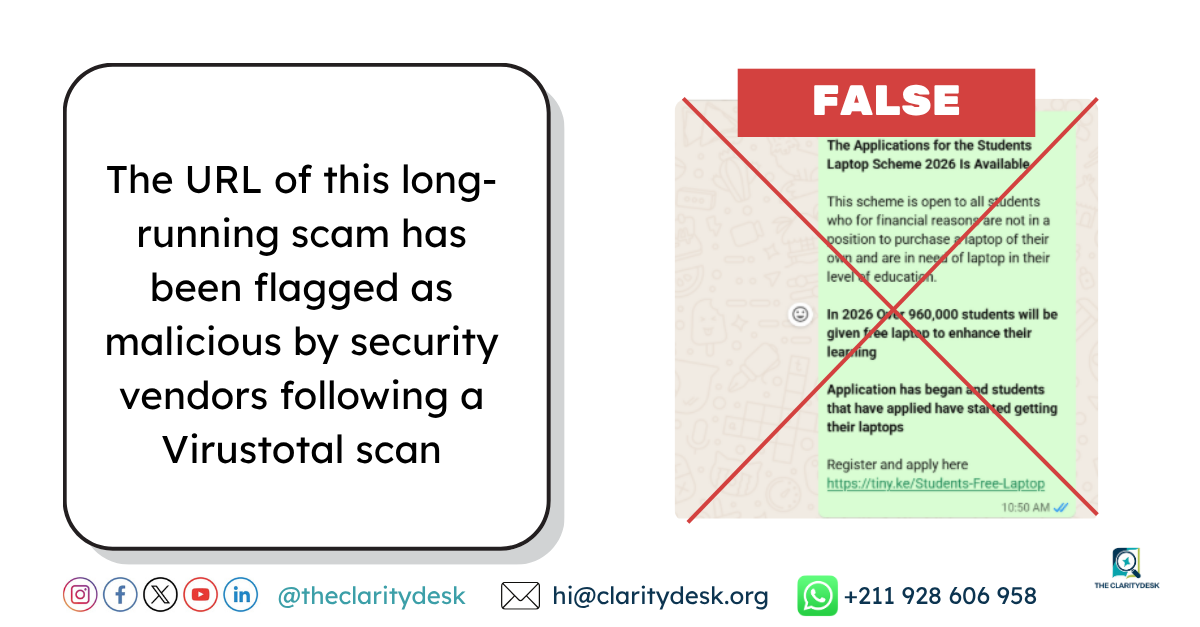
A viral claim being shared on WhatsApp about “Students Laptop Scheme 2026” is false.
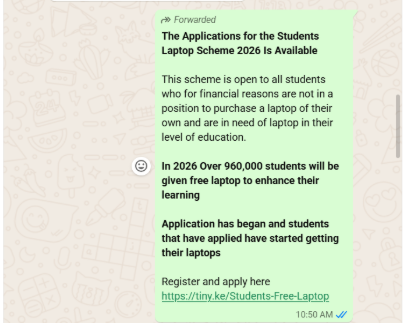
The message, which has been forwarded to many WhatsApp groups and direct messages, has been making the rounds since early February 2026.
“In 2026 Over 960,000 students will be given a free laptop to enhance their learning. Application has begun and students that have applied have started getting their laptops,” the WhatsApp message reads in part with a link to apply.
Debunking the Claim:
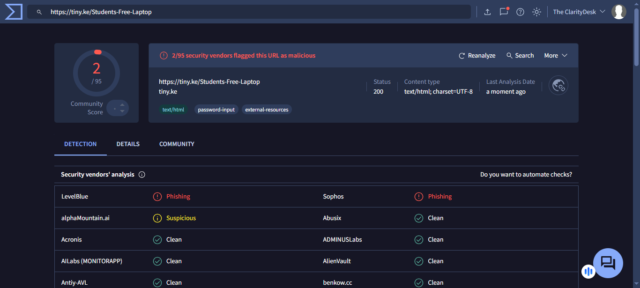
A URL scan via Virustotal has flagged this URL as malicious by two security vendors.
Furthermore, neither the WhatsApp message nor the website provides information on the organisation responsible for the said laptop scheme.
The links provided in the claim such as tiny.ke/Students-Free-Laptop and achievedreams.hights.buzz fit a well-documented pattern of global phishing scams falsely promising free laptops to students using persuasive language, exaggerated numbers , and short or obscure domains to appear legitimate according to cybersecurity experts.
Independent fact-checkers including 211 Check and FactCheckNG have confirmed that no such universal laptop distribution program exists, and that these campaigns are designed to trick users into submitting personal information or clicking malicious links.
The structure of these sites—requesting personal details, urging users to share links, and lacking official government domains—is consistent with phishing operations. Experts say that engaging with them can lead to data theft, malware infection, or financial fraud.
Our Verdict:
The ClarityDesk finds the claim being widely shared on WhatsApp groups and direct messages about the application for student’s laptop scheme 2026 to be false.
The URL of this long-running scam has been flagged as malicious by security vendors following a Virustotal scan.
This article is published by The ClarityDesk, with the support of the Election Civic Tech Fund of AfricTivistes, within the AHEAD Africa and Digitalise Youth projects, led by the Digital Democracy Initiative.
Have you spotted an error in this article and would like to request a correction, or have you come across a claim that we should investigate? Please send us an email via editor@claritydesk.org or click here to WhatsApp us via +211 928 606 958.
About The ClarityDesk
The ClarityDesk is a media integrity project based in South Sudan dedicated to promoting truth, transparency, and accountability. Working at the intersection of fact-checking, solutions and data journalism, we verify claims, debunk misinformation, and equip the public with tools to critically evaluate information. Our work is guided by accuracy, independence, and the public interest.
 Ajah Jennifer Mayen
 Dhel Malith Chol