 Dhel Malith CholMarch 31, 2026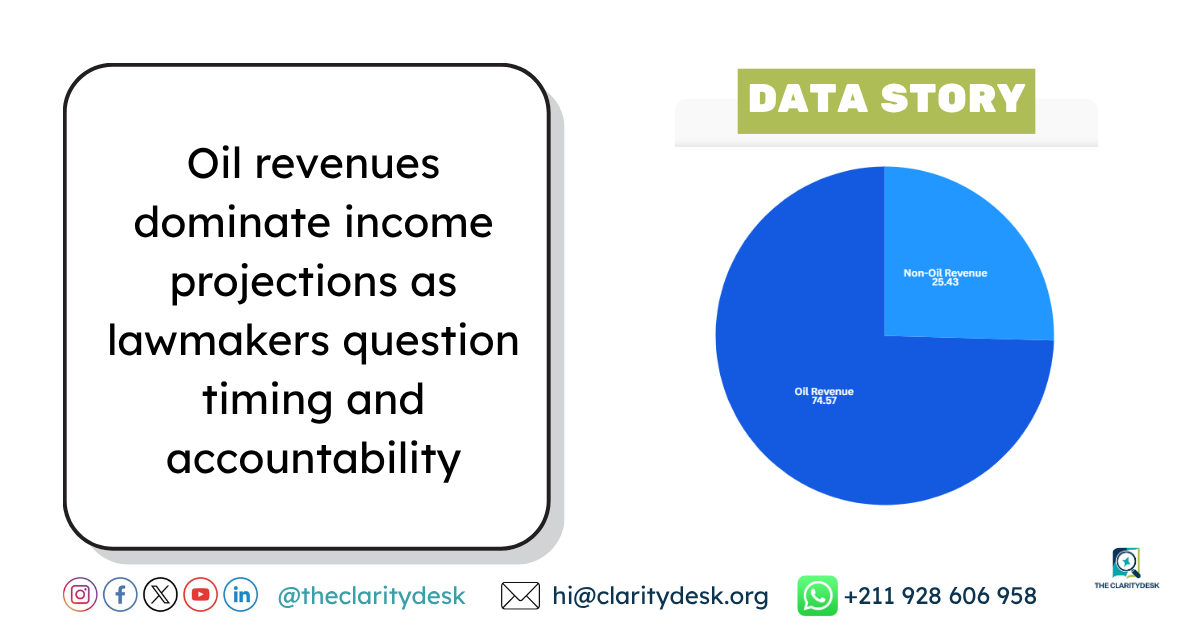
South Sudan has tabled a long-awaited SSP 7.00 trillion draft national budget for the 2025/26 financial year, presenting what the government describes as a stabilization-focused spending plan. The proposal, introduced to the Transitional National Legislative Assembly (TNLA) by former Finance Minister Bak Barnaba Chol, outlines a fiscal framework that prioritizes wages, debt servicing, and infrastructure while projecting a significant deficit.
According to a report by Radio Tamazuj, the government expects total revenues of SSP 7.00 trillion against planned expenditures of SSP 8.58 trillion, resulting in a fiscal deficit of SSP 1.58 trillion.
Graph 1.0 showing the distribution of the total budget distribution.
Source: Flourish
“For FY 2025/26, the fiscal aggregates are as follows: total revenue of SSP 7.00 trillion, total expenditure of SSP 8.58 trillion, and a fiscal deficit of SSP 1.58 trillion,” former Minister Chol told lawmakers during the presentation while still in office.
Revenue Structure: Heavy Reliance on Oil
The draft budget shows that oil remains the backbone of public finances. Of the projected SSP 7.00 trillion in revenue, SSP 5.22 trillion — roughly three-quarters — is expected to come from oil. Non-oil revenues are projected at SSP 1.78 trillion.
A pie chart showing the sources of the budget funding.
Source: Flourish
The former minister emphasized that the budget is “fully domestically financed”, reflecting an attempt to reduce reliance on external borrowing during a period of fiscal stress. However, the revenue composition indicates that diversification beyond oil remains limited.
Economic observers have previously noted that oil-dependent economies are vulnerable to global price fluctuations and production disruptions, factors that can affect fiscal stability. The dominance of oil revenues in this budget suggests continued exposure to such external risks.
Expenditure Priorities: Salaries Lead Spending
On the spending side, wages and salaries receive the largest allocation at SSP 1.90 trillion. This represents a substantial share of total expenditure and signals the government’s effort to meet its obligations to civil servants and security forces.
Debt servicing is allocated SSP 842 billion, while infrastructure development receives SSP 1.17 trillion. Capital projects account for SSP 1.29 trillion.
“Sectoral allocations prioritise infrastructure, security, rule of law, and economic functions,” Minister Chol said, adding that humanitarian and health sectors would continue to benefit from off-budget support provided by development partners.
The allocation pattern suggests a dual focus: maintaining government operations through wage payments while investing in physical infrastructure and capital projects intended to support long-term growth.
Graph 3.0 showing the distribution of the budget funds to different government sectors.
Source: Flourish.
Managing the Deficit and Debt
With expenditures exceeding revenues by SSP 1.58 trillion, the government plans to finance the deficit through grants and concessional financing aligned with public financial management reforms. The minister also cited exchange-rate reunification measures coordinated with the Bank of South Sudan as part of broader macroeconomic stabilisation efforts.
To address debt obligations, the government has earmarked USD 187 million for servicing both principal and interest payments in FY 2025/26. According to the minister, this allocation aims to restore sovereign credibility and reduce exposure to litigation.
Chol described the proposed budget as “a discipline-driven stabilisation budget, focused on restoring macroeconomic balance, honouring public obligations, strengthening institutions, and laying the foundation for sustainable growth.”
Parliamentary Concerns: Timing and Oversight
Despite the formal presentation, some members of parliament questioned the timing and procedural compliance of the budget. Samuel Buhari Loti, MP for Torit County, argued that the draft was presented later than constitutionally required and claimed that lawmakers had not received expenditure reports.
He stated that the delay meant the Assembly was reviewing a budget that was already largely spent, and he raised concerns about compliance with reporting requirements under the Appropriation Act.
In response, Speaker Jemma Nunu Kumba urged lawmakers to allow the presentation to proceed, noting that the formalization was necessary despite challenges affecting the country. She emphasized the importance of enabling the Ministry of Finance to move forward with preparations for the 2026/27 fiscal year.
A Stabilization Budget Under Scrutiny
The 2025/26 draft budget presents a picture of a government attempting to balance fiscal consolidation with operational needs. The figures show a strong emphasis on salaries and debt servicing, continued reliance on oil revenues, and planned investment in infrastructure and capital projects.
At the same time, parliamentary concerns over timing and expenditure reporting highlight ongoing debates about transparency, fiscal discipline, and legislative oversight.
As the TNLA reviews the draft, the data reflects both the scale of South Sudan’s fiscal ambitions and the structural pressures shaping its public finances in the year ahead.
This article is published by The ClarityDesk through the Young Journalists Media Integrity Fellowship, with the support of the Election Civic Tech Fund of AfricTivistes, within the AHEAD Africa and Digitalise Youth projects, led by the Digital Democracy Initiative.
Have you spotted an error in this article and would like to request a correction, or have you come across a claim that we should investigate? Please send us an email via editor@claritydesk.org or click here to WhatsApp us via +211 928 606 958.
About The ClarityDesk
The ClarityDesk is a media integrity project based in South Sudan dedicated to promoting truth, transparency, and accountability. Working at the intersection of fact-checking, solutions and data journalism, we verify claims, debunk misinformation, and equip the public with tools to critically evaluate information. Our work is guided by accuracy, independence, and the public interest.
 Ajah Jennifer Mayen
 Gabriel Garang